


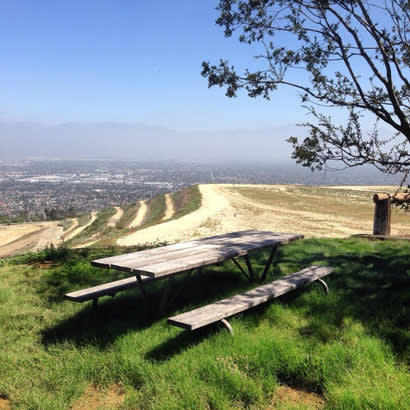
Pictured: Puente Hills Landfill in Los Angeles, California, is being transformed into parkland.
Finding land for new parks is becoming one of the biggest challenges facing urban communities. In Los Angeles County and other densely developed regions, land is limited, costly and often already committed to existing uses, even as the need for community space — for recreation, cooling, gathering and respite — continues to grow.
Climate change is intensifying heat and environmental stressors, while disparities in access to parks and green space remain deeply entrenched. In this context, the question is not whether to invest in parks, but where and how to create them in an already built-out landscape.
Increasingly, the answer lies in rethinking what constitutes parkland. Rather than relying solely on vacant parcels, agencies are reclaiming land shaped by legacy infrastructure, industrial uses and public systems. These efforts—ranging from large-scale transformations to smaller, distributed interventions—require coordination, remediation and sustained investment, but offer some of the most promising opportunities to expand access to open space in communities that need it most.
Landfills
Across LA County, former landfills have been transformed into parks and gardens, demonstrating how heavily impacted sites can be reclaimed for public use. The Puente Hills Landfill, spanning over 1,300 acres, represents one of the most ambitious examples. Today, the County is in the process of transforming 142 acres of the landfill into parkland, creating the first new regional park in the county in more than 35 years.
The proposed park will offer recreational and educational programming for residents of the San Gabriel Valley and surrounding communities. A key early component is the Hilda L. Solis Environmental Justice Center, currently under construction, which will serve as a hub for education, workforce development and community engagement. While much of the landfill will remain under long-term environmental management, this phased approach demonstrates how constrained sites can begin to deliver tangible benefits over time.
Airports
Airports occupy large, centrally located parcels that are seldom available for alternative uses. The planned closure of Santa Monica Airport presents an opportunity to repurpose approximately 192 acres of land in a highly urbanized setting.
The City of Santa Monica is advancing plans for a “Great Park,” with the site envisioned for parks, open space and recreational uses. While the final program continues to evolve through community engagement, the direction is clear: to transform a site long dedicated to aviation into a major public amenity.
Opportunities of this scale are exceptionally rare. The conversion of the airport site has the potential to deliver substantial new parkland while addressing longstanding gaps in access to open space, illustrating how specialized infrastructure can be reimagined to serve broader community needs.
Oil Extraction Sites
Oil-related land uses are widespread across LA County, ranging from small parcels to large sites such as the approximately 1,000-acre Inglewood Oil Field. Many are located near residential communities that have long experienced environmental burdens and limited access to parks and recreational facilities.
As jurisdictions move toward phasing out oil production, attention is turning to what comes next. Addressing this transition requires more than well plugging and environmental remediation; it requires a parallel focus on land reuse to ensure these sites are repurposed for community benefit.
The Parks Needs Assessment Plus (PNA+) supports this approach by calling for the restoration of degraded lands, including oil fields and drilling sites, as a strategy to expand park access in high-need communities. The redevelopment of the former Jefferson drill site, where community-based organizations have been working with residents to advance plans for neighborhood-serving uses, illustrates how smaller properties can be repurposed for local benefit.
Gas Station Sites
Former gas station sites represent a distributed and often overlooked opportunity for urban greening. Many are classified as leaking underground storage tank (LUST) sites, requiring environmental cleanup before reuse.
The PNA+ Implementation Plan identifies these sites as part of a broader strategy to reclaim underutilized land. Although individually small, their cumulative impact can be significant, especially in dense neighborhoods where larger sites are not available.
With appropriate remediation and design, these sites can become pocket parks, plazas or other community-serving spaces. Their visibility and proximity to residents make them especially valuable for delivering immediate benefits at the neighborhood scale.
Flood Control and Utility Corridors
Flood control infrastructure extends for hundreds of miles across LA County, including major systems such as the Los Angeles and San Gabriel Rivers. Increasingly, these corridors, along with utility rights-of-way, are being reimagined as multi-benefit spaces that support recreation, habitat and active transportation.
The Urban Natureways initiative builds on this shift, establishing a new parkland classification for corridor-based greenways that deliver ecological, recreational and mobility benefits. It draws on decades of work by public agencies and community-based organizations and calls for incorporating key segments into the County’s Regional Trail Network while improving coordination across entities.
By leveraging existing infrastructure, Urban Natureways can create continuous networks of accessible green space in areas where traditional park development would be difficult or cost-prohibitive. These efforts are designed to work within the primary functions of flood control systems while expanding public access and environmental benefits, requiring coordination across multiple agencies and regulatory frameworks. They reflect a broader shift in how infrastructure is viewed—not only as functional systems, but as opportunities to reconnect communities and expand access to nature.
Streets
In many communities, the most immediate opportunity to expand green space lies within the public realm. Streets, sidewalks and parkways represent a vast network of publicly controlled land that can be leveraged to deliver environmental and community benefits.
Through implementation of the Community Forest Management Plan (CFMP), LA County is planting new trees along streets and in parks, prioritizing communities with high canopy need. This helps to create more park-like communities where the benefits of green space are integrated into everyday environments.
Over time, a more continuous tree canopy can transform neighborhoods by providing shade, reducing heat and enhancing walkability. At the same time, efforts are expanding beyond planting to include the removal of excess pavement, creating new space for greening in the public realm.
Analysis from the DepaveLA initiative highlights the opportunity to repurpose “non-core” pavement—areas not required for roads or essential access—into greener, more functional community space. Targeted depaving in places like schoolyards, parking lots and underutilized rights-of-way can support tree planting, stormwater capture and small-scale recreational amenities, reinforcing the idea that even highly built environments contain opportunities for transformation.
A Different Way of Seeing Land
Taken together, these examples reflect a broader shift in how land is understood and used in urban environments. In regions where vacant land is scarce, expanding access to parks and nature depends on the ability to unlock opportunities within existing systems and previously developed sites.
This approach requires coordination across agencies, alignment with regulatory frameworks and sustained engagement with communities. It also requires patience, as many of these transformations unfold over years or even decades, and a commitment to aligning efforts such as the PNA+ and CFMP into a cohesive strategy.
The potential payoff is significant. By reclaiming land shaped by past uses and reimagining it for community use, these efforts address environmental legacies while expanding access to recreation, improving public health and strengthening climate resilience. Even in the most built-out environments, we can reclaim space for community, recreation and respite when we see and seize opportunities for transformation.
Clement Lau, DPPD, FAICP, is a planner and writer with over 17 years of park planning experience in Los Angeles County. He is a regular contributor to NRPA's Parks & Recreation magazine and Open Space blog.