


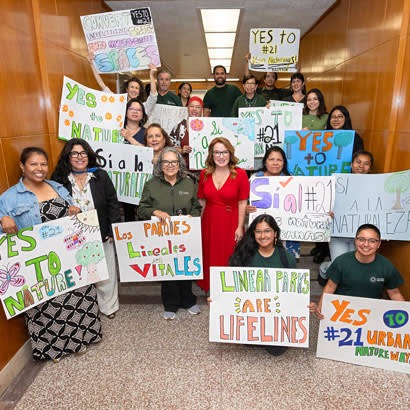
Pictured: Community partners celebrate the launch of Los Angeles County’s Urban Natureways initiative. Photo courtesy of County of Los Angeles.
Local parks and recreation agencies are being asked to do more than ever before. Across the country, parks are expected to advance sustainability, public health, climate resilience, biodiversity, youth development, and social connection while continuing to provide safe and welcoming spaces for community, recreation, and respite. At the same time, many park agencies are facing budget cuts, staffing shortages, and aging infrastructure. In this environment, one thing has become increasingly clear: public agencies cannot do this work alone.
Partnerships are playing an increasingly important role in helping park agencies meet growing public expectations and community needs. They may involve nonprofit foundations, community-based organizations, coalition building, or public-private partnerships that advance major initiatives and projects. Effective partnerships expand organizational capacity, strengthen public trust, bring new expertise and funding sources to the table, and enable agencies to respond more effectively to local needs and challenges. Los Angeles offers several examples of what these partnerships look like in practice.
Park Foundations as Partners
One increasingly important model is the creation of park foundations that work alongside public agencies to support fundraising, advocacy, programming, and long-term stewardship. For example, the Los Angeles Parks Foundation has supported projects throughout the City of Los Angeles, including the Community School Parks Initiative, repair and renovation of recreational facilities like playgrounds and sports courts, and tree planting at parks. The organization has also been aiding in wildfire recovery efforts through fundraising and restoration work at parks impacted by the Palisades Fire, including Palisades Park and George Wolfberg Park.
Similarly, the Los Angeles County Parks Foundation was established to support the County’s Department of Parks and Recreation (LA County Parks) through philanthropy, partnerships, and community investment. In the aftermath of the Eaton Fire, the foundation has played an important role in supporting the reopening of Loma Alta Park, helping restore access to a vital community gathering space and recreational resource. The foundation is currently focused on recovery projects at Eaton Canyon Natural Area, rebuilding of the Eaton Canyon Nature Center, improvements at Charles S. Farnsworth Park, and repair and restoration of trails and other recreational assets impacted by the fire. These efforts illustrate how foundations can mobilize additional resources and public attention during times of crisis and recovery.
More recently, the Exposition Park Foundation was launched to support the future of Exposition Park through public-private partnerships and philanthropic investment. The foundation’s efforts are tied to broader improvements associated with upcoming international events, including the 2028 Olympic and Paralympic Games. Priorities include sustainability initiatives, accessibility upgrades, infrastructure modernization, greening efforts, public safety enhancements, and community programming that will shape the future of one of Southern California’s most visited public spaces.
These organizations reflect an important reality: successful park systems increasingly depend on networks of support that extend beyond government alone. Foundations can cultivate donors and advocates, leverage funding, build public awareness, and create flexibility that public agencies may not have on their own. Importantly, these partnerships do not replace the need for sustained government funding for parks and recreation. Rather, they help amplify the impact of public resources and investments.
Community Partnerships and Coalition Building
Partnerships are equally important at the community level. Some of the most meaningful park and open space planning and implementation efforts in LA County have depended on collaboration with community-based organizations, conservancies, residents, advocates, philanthropic partners, and local leaders.
The Los Angeles Countywide Parks Needs Assessment (PNA), Parks Needs Assessment Plus (PNA+), and the PNA+ Implementation Plan have relied heavily on partnerships with community-based organizations, conservancies, Tribal governments and stakeholders, advocates, and local residents to identify park inequities and shape priorities for future investments. Community engagement is not treated as a procedural requirement, but as central to understanding how park and recreation investments could better serve historically underserved communities. These partnerships elevate local knowledge, build trust, and ensure that planning efforts reflect real community needs and lived experiences.
Coalition building has also played an important role in initiatives such as Urban Natureways, which seeks to transform underutilized flood control channels, utility corridors, and other spaces into connected networks of trails, habitat, parks, and green infrastructure throughout LA County. The initiative brings together public agencies, nonprofit organizations, community advocates, and local stakeholders around shared goals related to equitable access to nature, mobility, climate resilience, habitat connectivity, and biodiversity.
Many of these efforts also rely on the leadership and support of elected officials and community leaders, including the LA County Board of Supervisors, City Council members, and Town Council representatives in unincorporated communities. Their policy direction, advocacy, local knowledge, and ability to convene partners often move initiatives from concept to implementation.
Efforts like these are often too ambitious and interconnected for any single organization to advance independently. They require coordination across jurisdictions, disciplines, and sectors, as well as long-term relationship-building and a shared commitment to broader public goals. Partnerships can help create the alignment necessary to move visionary ideas into reality.
Public-Nonprofit Partnerships in Action
Another important partnership model can be found in the operation and stewardship of public gardens. Specifically, LA County Parks operates several gardens in partnership with nonprofit organizations, including the Descanso Gardens Foundation, Friends of Robinson Gardens, Los Angeles Arboretum Foundation, and South Coast Botanic Garden Foundation. These collaborations support fundraising, preservation, educational programming, capital improvements, and long-term stewardship at some of the region’s most important public gardens.
For example, a recent groundbreaking ceremony at Descanso Gardens highlighted the value of multi-agency and nonprofit collaboration. The projects include a major stormwater capture and water reclamation system, lake and habitat improvements, and wildfire resilience investments designed to support the long-term sustainability of the gardens. The stormwater system alone is expected to capture up to 21 million gallons of stormwater annually for reuse in irrigation, lake replenishment, and habitat support.
This effort involves partnerships among LA County Parks, the Descanso Gardens Foundation, the Los Angeles County Flood Control District, the California Wildlife Conservation Board, the Los Angeles County Regional Park and Open Space District, and private donors. This type of collaboration demonstrates how organizations can combine expertise, funding, and institutional capacity to achieve outcomes that might otherwise be difficult for a single entity to accomplish. It also illustrates how partnerships can support not only recreation, but broader environmental goals related to water conservation, habitat enhancement, climate adaptation, and public education.
Looking Ahead
As communities continue to face challenges related to climate change, aging infrastructure, public health, and equitable access to parks and open space, partnerships will only become more important. Local park agencies remain essential because they provide leadership, accountability, long-term stewardship, and a commitment to serving the public interest. However, the scale and interconnected nature of today’s challenges increasingly require collaboration across sectors and disciplines.
Partnerships can help unlock funding, strengthen trust, expand engagement, accelerate implementation, and bring new energy to parks and recreation work. In many ways, the future of parks and recreation will be shaped not only by the capacity of individual agencies, but also by the quality of the relationships and collaborations they build. At a time when many park agencies are being asked to do more with less, those partnerships matter more than ever.
Clement Lau, DPPD, FAICP, is a planner and writer with over 17 years of park planning experience in Los Angeles County. He is a regular contributor to NRPA's Parks & Recreation magazine and Open Space blog.