


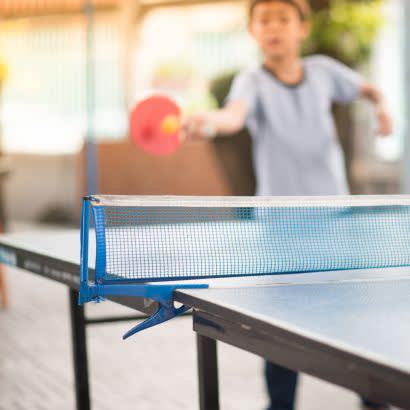
The table is not fancy. It folds in half, the net clips on and off, and the small white ball seems determined to escape at every opportunity. It sits in the community room of my parents’ condo, one of those shared spaces people pass through more often than they linger in. Lately, though, that table has become a gathering place.
After a long break, I recently started playing table tennis again when my parents moved into their new place. What began as a casual way to pass the time quickly turned into something more meaningful. My daughter picked up a paddle for the first time and immediately enjoyed it. My parents—now in their seventies—still play, their movements a bit slower but their instincts intact. Three generations now gather around the same table, laughing, missing easy shots, and celebrating the occasional perfect rally.
What strikes me most is how naturally table tennis brings us together. There is no sign-up sheet, no uniform, and no barrier to entry. We do not need to be equally skilled or fast. The game adapts to us, not the other way around. In a world where so much recreation feels segmented by age, ability, or experience, table tennis meets everyone where they are.
For me, returning to the game is also deeply personal. I grew up playing table tennis in Hong Kong, where the sport is woven into everyday life. It was not something you had to seek out; it was simply there. Tables could be found at schools, community centers, apartment buildings, and churches. At one point, my family had our own table tucked into our garage, its surface worn smooth from years of use.
In many Chinese households, table tennis is not framed as a competitive sport reserved for the most athletic. It is a social activity and a shared language. It is common to see grandparents playing with grandchildren, neighbors rotating in and out, and games starting and stopping without ceremony. The point is not perfection or winning—it is participation. The steady rhythm of the ball moving back and forth becomes a backdrop for conversation, teasing, and connection.
That rhythm feels familiar now as I watch my daughter learn the game. She does not worry about technique or score. She just wants to keep the rally going. My parents offer gentle encouragement and the occasional tip, and every so often she surprises us all with a sharp return. I find myself in the middle—old enough to remember playing more seriously, young enough to still chase the ball when it rolls under a chair. It is a rare moment where age differences do not create distance but instead add texture to the experience.
Table tennis endures because it asks so little and gives so much. It requires minimal space and equipment. It can be played indoors or outdoors, competitively or casually. It is forgiving of joints and adaptable to a wide range of physical abilities. You can play intensely for ten minutes or linger over a slower game for an hour. Few recreational activities are so flexible—and so democratic.
This is where the lesson extends beyond my family and into a broader conversation about parks, recreation, and shared spaces. We often focus on large, visible investments: new facilities, major renovations, and signature projects. Those investments matter. But sometimes, the most powerful recreational opportunities may come from modest amenities that invite people to gather without pressure or pretense.
A single table tennis table can activate a community room, a park pavilion, or a corner of a recreation center. It creates a reason to stay a little longer, to interact with someone you might otherwise pass by, and to bridge generations that rarely share the same recreational space. In doing so, it turns underused areas into places of connection.
In an era when loneliness and social fragmentation are growing concerns, these small points of contact matter. Recreation is not only about physical health or organized programming. It is also about creating environments where relationships can form naturally, where play becomes a form of social infrastructure.
It would have been easy to miss this. My parents could have walked past the table without stopping. My daughter could have stayed on her phone instead of picking up a paddle. I could have dismissed it as a game from my past. Instead, we keep returning, drawn back by something simple and shared.
The ball still bounces unpredictably, and rallies still end too soon. What lingers, though, is something more durable: moments of connection layered onto an ordinary space. Sometimes, all it takes is a table, a couple of paddles, and a willingness to play. That is where generations meet—and where community quietly takes shape.
Clement Lau, DPPD, FAICP, is a planner and writer with over 17 years of park planning experience in Los Angeles County. He is a regular contributor to NRPA's Parks & Recreation magazine and Open Space blog.