


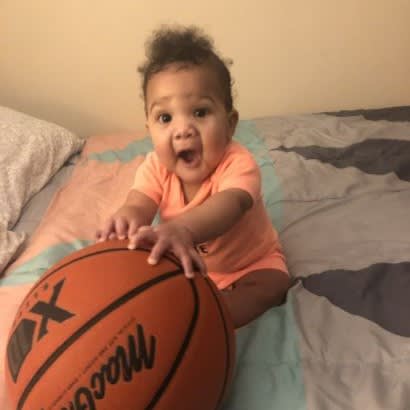
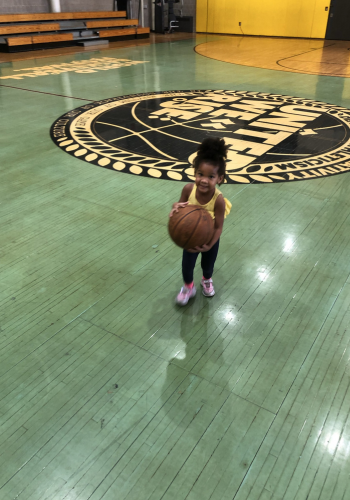
Pictured: Brian McFadden's daughter holds a basketball.
My father put a basketball in my crib when I was 2 years old. Allegedly.
What I know for certain is what came after. From age 6 to 22, basketball was the organizing principle of my life. It took me all the way to Division II. It gave me friendships I still have today, and taught me more about discipline, resilience, and being part of something bigger than myself than anything that happened in a classroom. I didn't just play a sport. I grew up inside one.
So when my daughter was born, I knew exactly what I wanted for her. She came into the world just a few months before COVID-19 shut everything down, and as any basketball fan knows, the pandemic gave us one unexpected gift: “The Last Dance.”
We'd sit together on the bed, her just a few months old, my basketball in reach, watching it every week like it was church. She'd reach for the ball. I'd let her hold it. I told myself it was only a matter of time.
It took a few years before I realized the world I was imagining for her didn't quite exist.
Getting Her Ready
As she got older, I started putting her in environments where sports felt natural. We'd go to the recreation center, and I'd lift her up to the hoop so she could feel what it was like to score. I'd kick a soccer ball back and forth with her, gently at first, so she could start to understand the motion of her body in relation to something moving. I wasn't just playing with her. I was preparing her — for real programs, real peers, real coaches. I wanted her to go from playing with daddy to falling in love with the game the way I had at her age.
Then we started looking for programs.
What we found — or rather couldn't find — stopped me cold. For her age group, girls-only programming was nearly nonexistent. The options that did exist were either designed for older kids or were co-ed in a way that didn't serve her.
This is the thing about co-ed that doesn't get talked about enough. It's not that boys and girls can't play together. It's that for a lot of girls, especially at that age, walking into a space dominated by boys before they've had the chance to build confidence in their own skills is intimidating. Girls need a place to find their footing first — to learn alongside each other, encourage each other and figure out who they are as athletes in an environment where they feel seen and supported. That sense of belonging doesn't happen by accident. It has to be built intentionally.
My daughter is reserved by nature. I knew that the wrong first sports experience could shape how she felt about sports for a long time. So, I waited. I kept looking. And I kept arriving at the same conclusion. The infrastructure I had taken for granted as a 6-year-old boy — a coach, a gym, a group of kids learning the same game together — simply wasn't there for my daughter. Not because she didn't deserve it. Not because she wasn't ready. But because nobody had built it for her yet.
I started to wonder: if my child, with a parent actively looking, can't find this, how many other girls aren't finding it either?
What Parks Can Do That Nobody Else Can
It turns out I wasn't alone. Girls face fewer opportunities than boys from the very start — less access to equipment and dedicated space, a sports culture that too often signals this world wasn't built for them, and a coaching landscape that rarely reflects or represents them. Across the country, girls are dropping out of sports at higher rates than boys or never getting the chance to play at all. This growing gap threatens not only girls’ physical health, but also their confidence, leadership development and long-term well-being. Because sports have the power to shape who girls become, ensuring access to positive, access to positive experiences centered on belonging and encouragement is more urgent than ever.
But here's what gives me hope. Parks and recreation is uniquely positioned to change this. Not because of any single program or policy, but because of what parks fundamentally are. They are community anchors. Trusted spaces where families already show up, where kids already feel at home, and where the relationships between neighbors run deep. Parks meet girls where they are — literally and figuratively. They exist in the neighborhoods, reflect the communities around them, and carry a mission to serve everyone equally. No other institution has that combination of reach, trust and local presence.
When park and recreation professionals build a girls-only program, it isn't just filling a gap in a schedule. It’s sending a message that girls belong here, that their development matters and that this community has invested in their future. That message, delivered consistently and early, is what keeps girls in the game long after the clinic ends.
What Belonging Actually Looks Like
As one of the largest providers of youth sports in the nation, local park and recreation agencies play a critical role in closing this gap, by offering affordable, community-based programs that reach millions of kids every year. That’s why earlier this year, NRPA launched the Get Her in the Game campaign, an initiative supported by Nike to create more welcoming and empowering sport environments for girls everywhere, through parks and recreation. Through Get Her in the Game, NRPA and Nike are equipping park and recreation professionals with the tools, research and resources needed to transform how girls experience sports in their communities.
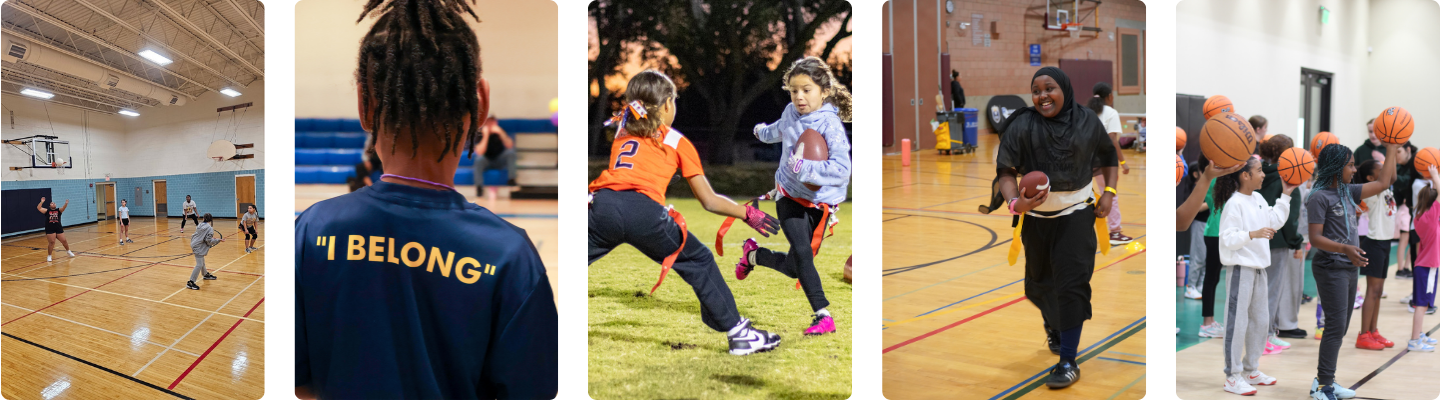
As NRPA continues to champion girls and women in sports, we want to recognize five park and recreation agencies making a real impact: Twentynine Palms (California) Community Services, the City of Tampa (Florida) Parks and Recreation, Columbus (Ohio) Parks and Recreation, the City of Douglasville (Georgia) Parks and Recreation, and the King County (Washington) Play Equity Coalition in partnership with the City of Seattle Parks and Recreation. Each program is free, locally led and built around a simple belief: when girls see themselves reflected in the sports offered, in the coaches and in the faces of the other girls in the room, they are far more likely to believe the program was meant for them.
One story from Douglasville, Georgia, captures this better than any statistic could:
“A young girl arrived with her grandmother, quiet and withdrawn, staying close at her side during warmups. She wasn't wearing the event T-shirt like the other participants. She seemed like she might not make it past the first station.
A coach noticed. She approached gently, and when the girl wasn't ready to talk, the coach offered her a shirt — the same one every other participant was wearing. That was enough. Something shifted. By the end of the day she had rotated through every single station. When organizers followed up afterward, she wanted to know how she could join the cheer team.
Her grandmother later shared that traditional ball sports had always been intimidating. Hand-eye coordination hadn't come easily, and her granddaughter often compared herself to her peers. But seeing varsity cheerleaders lead the session — older girls who looked like her, cheering her on — made it feel different. It felt welcoming. Supported. Like something that was built for her.”
That's the blueprint. Not a shirt. Not a cheer routine. Belonging, delivered intentionally, before the first drill ever starts.
What stands out across all five programs isn't just what they did — it's how they thought about it. Each one put representation at the front of the room, met girls in their own communities and connected a single day to something larger down the road. Taken together, these agencies may have quietly developed the framework the rest of the field has been seeking — replicable, adaptable and grounded in a simple truth: every girl deserves a program designed with her in mind from the very beginning.
What You Can Do
Those who work in parks and recreation already feel this problem. You've seen the registration numbers skew. You've watched girls age out of programs that weren't designed to keep them. You may have an idea that's been waiting for a budget line or a champion.
Here's where to start. Look at your programming calendar and honestly ask whether girls have as many entry points as boys — at age 6, at age 9, at age 12. Then look at your coaching roster and ask the same question. Recruiting and retaining women coaches isn't a nice-to-have. It's a participation strategy. Then look at how your facilities and equipment are allocated. Girls' programs should receive the same quality and investment as boys' programs. That's not an aspiration. It's a baseline.
NRPA's Get Her in the Game playbook has concrete tools for every one of these questions — how to audit your marketing so girls can see themselves, how to build a coaching pipeline, how to change the policies and practices that quietly tilt toward boys' programs, and how to bring girls into the design of the programs meant to serve them.
And if you want to go deeper, join us on April 15 for a webinar where park and recreation professionals from across the country discuss these strategies and share what's working on the ground. Whether you are just starting out or ready to take your existing efforts to the next level, this is a conversation you don't want to miss.
Will We Build It?
My daughter is 6. She is reserved by nature — the kind of kid who stays close, watches before she moves, and needs to feel like a space was built for her before she'll step into it. When I heard about that girl in Douglasville, I saw my daughter completely. Same temperament. Same hesitation. Same potential waiting on the other side of the right environment.
That's the program I've been looking for. I just need someone to build it in our park.
So do millions of girls like her. The question is whether we'll build it.
What does girls' programming look like at your agency? Are there gaps you're working to close or wins worth sharing? Drop a comment below or reach out directly. Let's keep this conversation going.
Brian McFadden is a program manager at NRPA.