


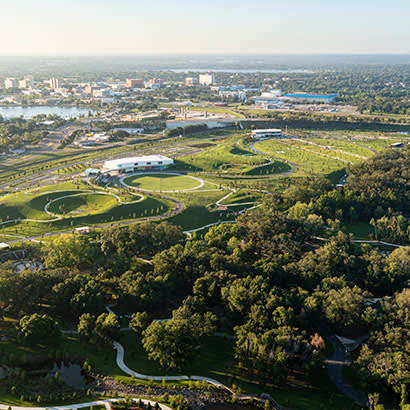
The success of parks for their communities relies equally on maintenance and operations as it does on design. When considering the environmental sustainability of our parks, both new and old, it is equally important to consider operations in conjunction with design and programming.
Unfortunately, landscape operations have not received the same attention from sustainability research and best practices as landscape construction or building facilities management.
To help guide maintenance and operations toward their sustainability goals, Sasaki and the National Recreation and Park Association (NRPA) have released “Environmentally-Friendly Park Management,” a guide that builds upon the Climate.Park.Change toolkit released in 2021.
This new guide offers a practical overview of the top environmental sustainability strategies that park departments are currently implementing and exploring. It highlights key strategies, shares lessons learned, and includes relevant references and case studies. The research is compiled from a literature review, a survey of over 150 park professionals, numerous interviews and 28 case studies. This represents the first national review of sustainable park operations in the United States.
The guide is available in report form on the NRPA website here. For park and recreation professionals interested in exploring specific sections and strategies, we have provided the guide as a series of cut sheets in the strategies section of the Climate.Park.Change website. In parallel, we have expanded Climate.Park.Change to include risk maps and strategies applicable to the entire continental United States. Now, park professionals can investigate climate risks and resilience strategies in their counties, and explore how to manage their parks for greater resilience and minimal environmental impact.
A Closer Look at Park Maintenance and Operations
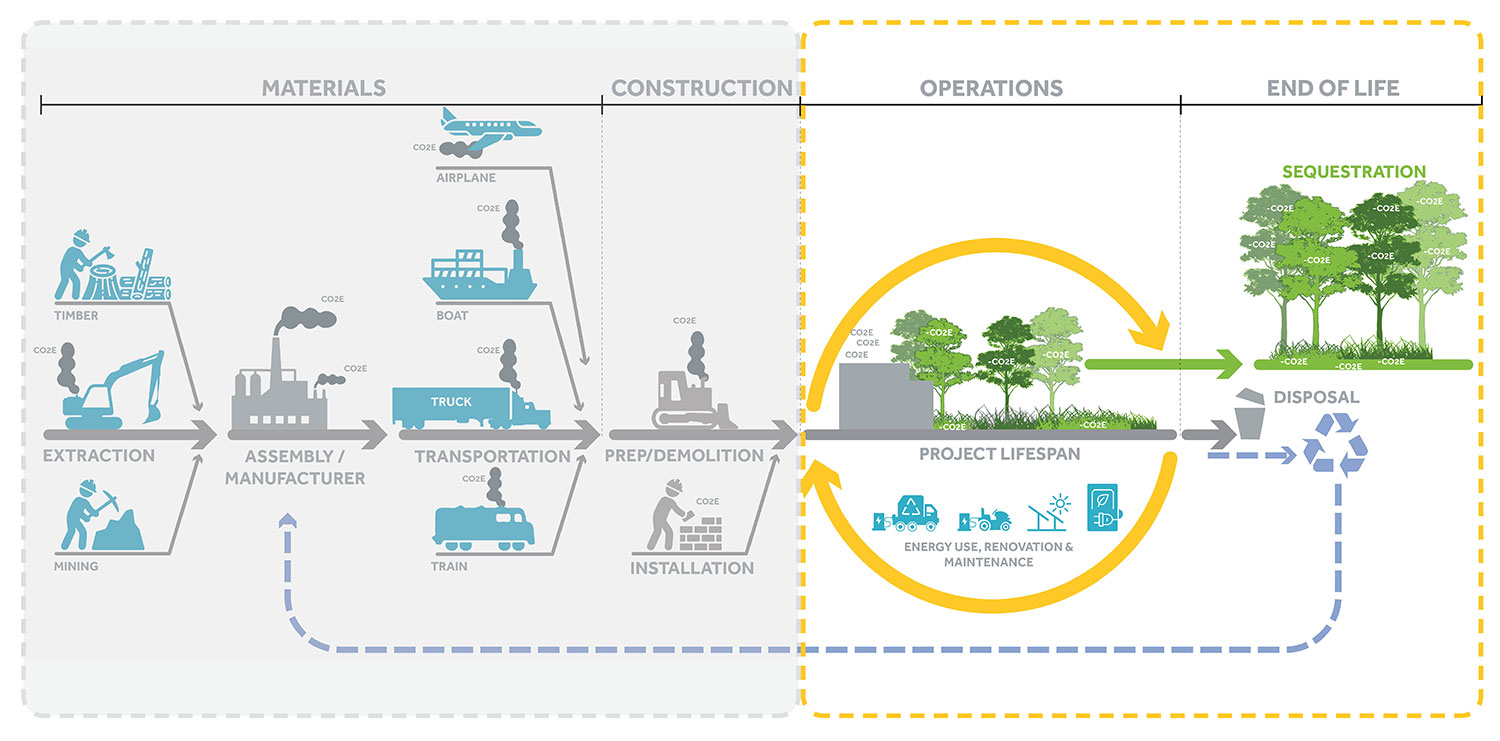
Operations and maintenance encompass the life cycle stages that follow the completion of construction. Operations and maintenance are critical components in understanding the environmental impacts of parks and park buildings, as well as the potential for ecological services, resilience and biodiversity.
The way we manage our landscapes can determine whether they are net-emitting or net-sequestering, whether they foster biodiversity or promote invasive species, and whether they effectively manage stormwater or exacerbate flooding events.
There is a common misconception that parks and outdoor spaces are inherently "green" and sustainable. Communities often focus more on the functional use and maintenance of parks and their infrastructure rather than on energy use, habitat quality or equipment emissions. However, this perspective is shifting. Increased interest in chemical-free environments, local air quality ordinances and active community advocacy groups are raising the demand for and scrutiny of park operations.
According to Architecture 2030, about half of the total emissions over a building's lifecycle are embodied (associated with construction), and half are operational. In contrast, Landscape Life Cycle Assessments tend to emphasize embodied emissions, with estimates ranging from 70-95 percent encapsulated, based on benchmarks from Climate Positive Design and internal studies at Sasaki. The operational requirements of landscapes can vary significantly, with larger regional parks featuring expansive natural systems differing greatly from densely programmed urban parks.
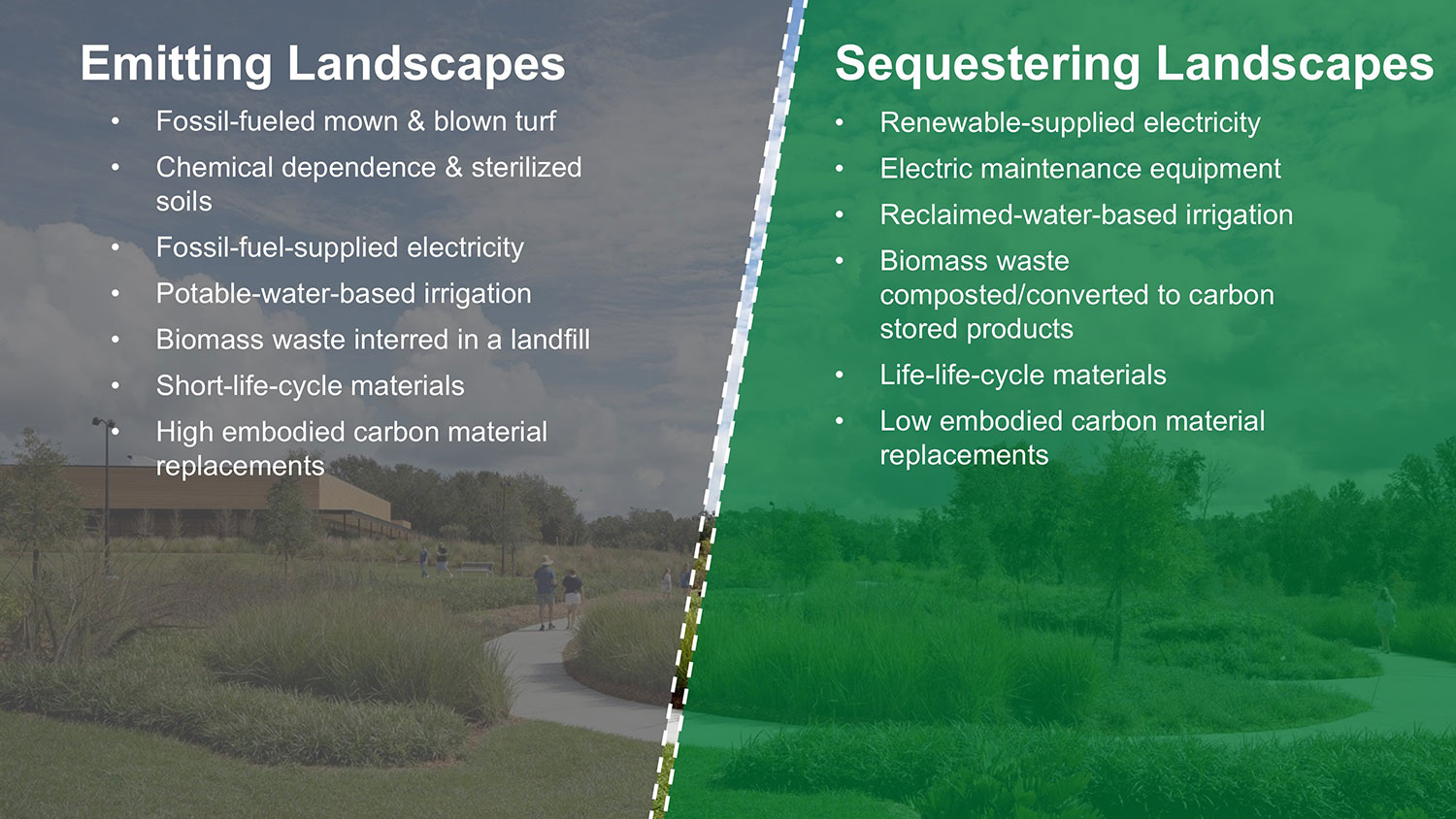
The same landscape can often be maintained in a sustainable or unsustainable manner, depending on the work done and equipment used.
Today, there are certifications that set rigorous benchmarks and expectations for sustainable landscape design, including LEED ND for neighborhood planning and the Sustainable SITES Initiative for landscape projects. Landscapes are also considered within building-oriented certification programs such as WELL and BREEAM. The literature for park professionals, including designers, administrators, and operations specialists, now includes robust resources for designing and managing sustainably built landscapes. While some standards address the operations of landscapes with high-level model assumptions, recommended maintenance practices, and reporting requirements, the reality is that a "sustainable landscape" can only be achieved through sustainable operations.
Guiding Decision-Making Practices
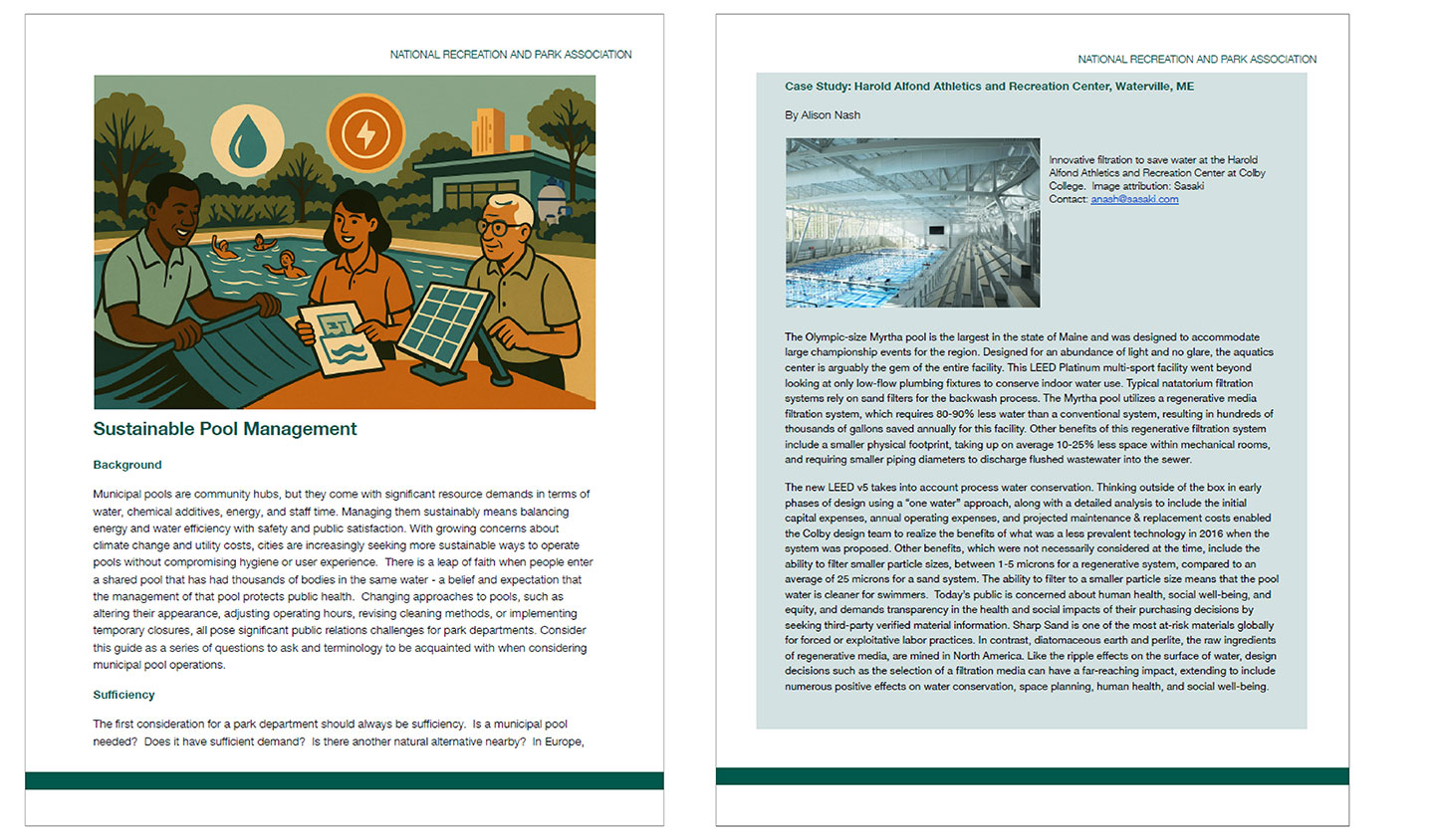
The guide includes 24 subject areas, 28 case studies and more than 360 references.
Landscape operations tend to operate independently of facility infrastructure, with grounds crews making critical decisions that affect the landscape. These decisions can significantly impact whether a landscape meets community expectations regarding design intent, visual appeal and perceived maintenance levels, as well as its energy and water use, chemical purchases and air pollution levels. They can also determine whether a park effectively sequesters and stores carbon over time or becomes a net source of emissions.
People Are Making It Happen
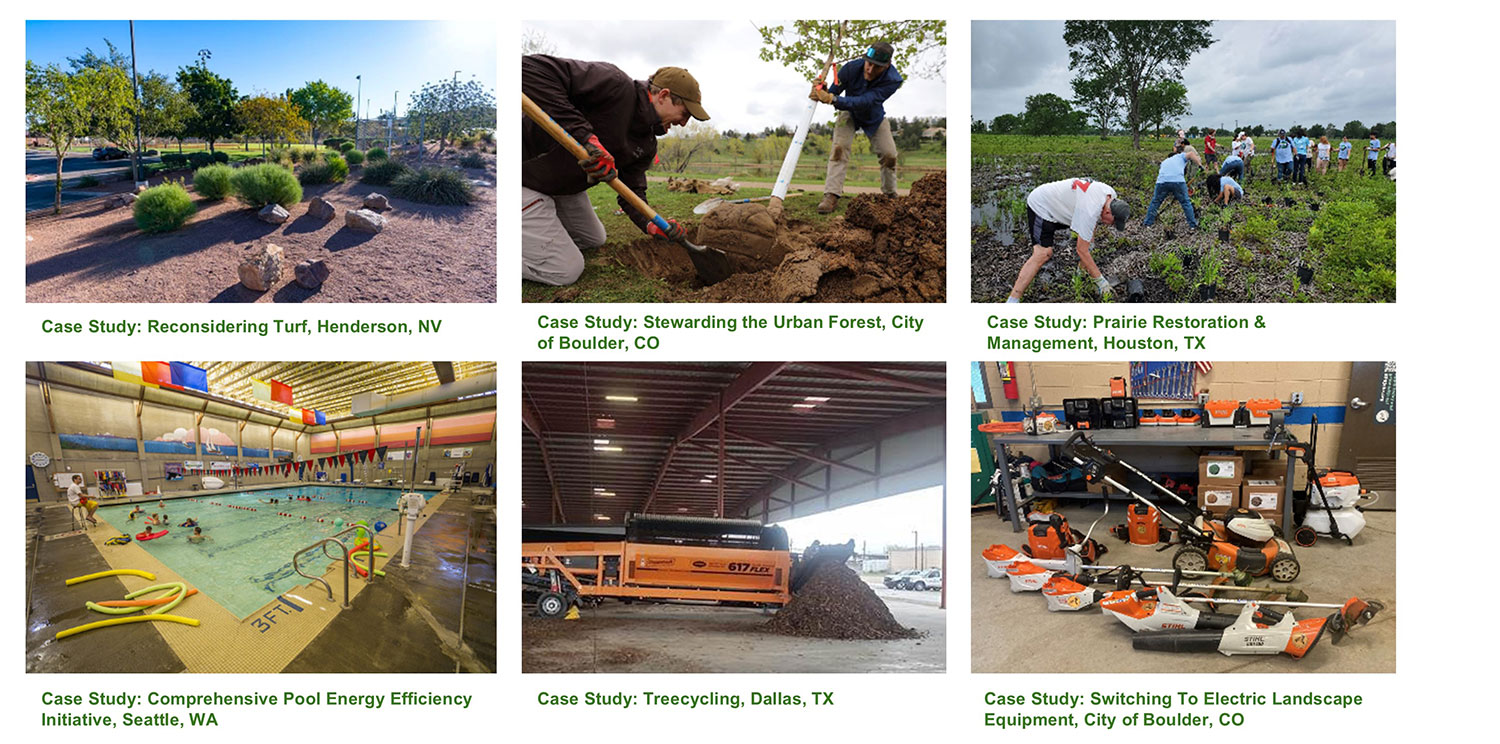
Park and recreation departments are already making this happen. Sharing methods can help expand impact and make exceptional efforts typical practice.
The “Environmentally-Friendly Park Management” guide reviews the current state of the industry, including potential operator challenges and pain points, for subjects such as water use efficiency, smart turf, renewable energy, efficient pool operations, waste management, energy efficiency and electrifying maintenance fleets. This guide also combines architectural facility best practices with landscape best practices, as park and recreation departments often manage both landscapes and buildings.
With all of this information, we hope to share lessons learned, inspire future action, and help make the exceptional work that parks professionals are already doing become standard best practices for the industry. Thank you to all the contributors, reviewers and participants in this exciting research project, as well as to the support and funding from NRPA leadership. And thank you to the park professionals and administrators — the work you do protects our parks, stewards our natural places and enriches our communities.
Chris Hardy is a senior associate at Sasaki.
Reviews of Environmentally-Friendly Park Management: Case Studies and Best Practices for Sustainable Public Space Operations:
"Managing urban parks in the face of climate change and biodiversity loss is a responsibility and a challenge for local park agencies. NRPA’s Climate.Park.Change online resource and the associated Environmentally Friendly Park Management Report are helpful tools to address the diverse, complex, and overlapping issues in public parks. In one place, these resources bring together relevant data on a variety of climate impacts, strategies to tackle them, and case studies to demonstrate how it can be done. Seattle Parks and Recreation values creating a Thriving Environment and Climate.Park.Change provides a useful guide for all our staff."
-Todd Burley, Sustainability Advisor, Seattle Parks & Recreation
"Parks and Recreation in all its forms is a great equalizer. To be a part of this profession is an honor that is not only to create joy and inspiration for all ages, but also to leave a legacy for future generations to partake. To that end, this compilation by NRPA and Sasaki is a leap forward toward offering a tool and information in one volume that discusses the peripheral aspects of our work—mainly the environment, and how best we address the challenges in a timely and proactive manner. So glad to see this work as a public-facing document."
-Subhajeet Seve Ghose, CPRE/MOL, Executive Director Yearba Buena Gardens Conservancy
"The Climate.Park.Change website and guide offer practical, field-tested tools to help park agencies embed sustainability into everyday operations and maintenance. The case studies and recommendations show how even small shifts in practice can reduce emissions, conserve water, and strengthen ecological health across park systems. Resources like this not only help park professionals care for the land — they also help us model environmental stewardship for the communities we serve."
-Clement Lau, DPPD, FAICP, Senior Analyst, Chief Sustainability Office, County of Los Angeles