


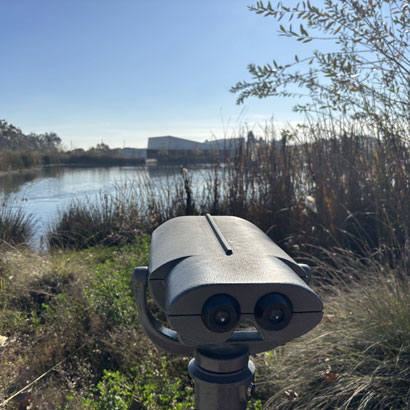
Pictured: A binocular viewer at Earvin "Magic" Johnson Recreation Area in Los Angeles, California. Photo courtesy of Clement Lau.
At Earvin “Magic” Johnson Recreation Area in South Los Angeles, it is easy to forget what came before. Today, its lakes, wetlands, walking paths, native landscaping, and gathering spaces form an oasis in a densely developed community. Yet this land was once the Athens Tank Farm, used to store and distribute petroleum products.
The contrast between the park’s past and present challenges us to think beyond the familiar image of conservation as the protection of large natural landscapes. Earvin “Magic” Johnson Recreation Area shows that conservation can also mean reclaiming degraded land and creating space for nature within a community where it is sorely needed.
That lesson extends well beyond one park. California’s 30x30 initiative seeks to conserve 30 percent of the state’s lands and coastal waters by 2030. Meeting that goal will require continued protection of large and ecologically significant landscapes. But achieving it equitably will also require pursuing land restoration opportunities in urbanized areas where millions of Californians already live.
Starting With Need
Urban conservation begins with understanding where needs and opportunities intersect. In many densely developed communities, the neighborhoods with the greatest need for parks, open space, shade, and access to nature are also the most challenging in which to provide them. Land costs are high, parcels are fragmented, development pressures are intense, and past industrial uses often present environmental constraints.
Los Angeles County’s planning experience offers one example of how local data can help. The 2016 Los Angeles Countywide Parks Needs Assessment (PNA) established a data-driven framework for identifying communities with the greatest park need, while the 2022 Parks Needs Assessment Plus (PNA+) broadened that lens to examine regional recreation and conservation opportunities and underscored the urgent need to regenerate degraded lands in urban communities.
The larger lesson applies throughout urban California. Park needs assessments, heat vulnerability data, urban forest plans, habitat studies, watershed plans, and community plans can help identify places where conservation investments may provide multiple benefits. Without this broader lens, statewide conservation efforts risk overlooking urban areas simply because the opportunities there are generally smaller, more fragmented, and more complex.
Finding Opportunity in the Urban Landscape
Urban conservation also requires seeing new possibilities in land not traditionally associated with parks, open space, or habitat. In built-out regions, promising opportunities may exist within infrastructure corridors and other spaces historically used for transportation, utilities, flood control, or other public purposes.
LA County’s Urban Natureways initiative reflects this approach by seeking to transform utility corridors, trails, flood control channels, and similar infrastructure into greener, more climate-resilient spaces. Similar opportunities exist throughout California wherever rivers, rail corridors, utility rights-of-way, channels, and other infrastructure already connect communities.
A trail with little shade or vegetation can gain trees, native landscaping, and habitat value. A flood control corridor can support recreation while also contributing to ecological restoration, and a utility corridor can help connect neighborhoods with parks, schools, waterways, trails, and regional open space. Individually, these projects may be modest, but together they can form broader conservation networks.
Brownfields and other degraded or underused properties can also play a role. They should not be treated as substitutes for protecting intact natural landscapes, but where remediation and reuse are feasible, land that currently offers little ecological or recreational benefit can be transformed to provide much more. In urban areas, conservation must include not only preserving what remains but also restoring damaged land so it can better support plants, wildlife, and people.
Recognizing Landscapes in Transition
Some conservation opportunities emerge because existing land uses are changing. The phaseout of urban oil drilling in LA County serves as one example. While attention often focuses on large oil fields, the region’s oil legacy is also dispersed across neighborhoods. Individual wells and small well sites can be found near homes, schools, parks, and commercial areas. Some occupy modest parcels that would barely register on a regional conservation map, yet their future reuse can still matter greatly to nearby residents.
As extraction ends and wells are plugged, oil well sites can take on new purposes, although reuse is rarely straightforward. Contamination, ownership, remediation costs, parcel size, and surrounding land uses all shape what is feasible. With the right planning, resources and partnerships, former oil sites may eventually be redeveloped to support parks, open space, housing, or other community-serving uses.
Not every former oil site should become parkland or open space. Some, however, may support native landscaping, habitat, community green space, trail connections, stormwater capture, or other forms of green infrastructure. Larger properties may allow for more substantial ecological restoration, while individual neighborhood well sites can support smaller interventions that improve local environmental conditions.
The same principle applies to former industrial parcels, obsolete infrastructure, excess rights-of-way, and other lands in transition. Conservation opportunity is not static; it can emerge as land uses and community priorities change.
Concluding Thoughts
California’s conservation goals are statewide, but the opportunities to advance them will look different from one community to another. When I look at Earvin “Magic” Johnson Recreation Area today, I see one powerful example of what that can mean: a place with an industrial past that now serves both people and nature in ways once difficult to imagine. Achieving 30x30 equitably will require California to continue protecting large and ecologically significant landscapes while also recognizing and investing in the various forms conservation can take, especially in urban communities where nature is deeply needed.
Clement Lau, DPPD, FAICP, is a planner and writer with over 17 years of park planning experience in Los Angeles County. He is a regular contributor to NRPA's Parks & Recreation magazine and Open Space blog.