


Those of us who work in parks and recreation have long understood the value of our work. Every day, parks provide places for people to exercise, play, gather, connect with nature and find respite from the demands of daily life. They support physical and mental health, environmental resilience, social connection and youth development. Yet understanding our impact is not the same as demonstrating it, and we cannot assume that the value of parks and recreation speaks for itself.
That distinction is particularly important during challenging fiscal times. Local governments across the country must make difficult decisions about how limited resources are allocated among many essential public services. Parks and recreation can be particularly vulnerable in these decisions, which makes it even more important for us to clearly demonstrate what public investments accomplish for people and communities. Doing so means looking beyond counts of facilities, programs and participants. It requires documenting our work, measuring our impact and communicating why it matters.
Combining Data and Stories
I have written previously about the importance of both telling our stories and using data visualization and storytelling to make the case for parks and recreation. Those ideas remain closely connected. Stories help people understand how parks affect individual lives and communities, while data can demonstrate the scale, reach and significance of those experiences. Numbers do not necessarily speak for themselves; we have to provide the context and narrative that make them meaningful.
That means looking beyond outputs to consider impact. The number of people participating in a recreation program is useful information, but so is whether the program is reaching those who previously faced barriers to participation. The number of trees planted matters, but so does where they were planted and whether they provide shade and other environmental benefits in communities that need them most. A new park is an accomplishment, but its significance becomes clearer when we explain the need it addresses and the people it serves. Understanding who benefits and whether investments are reaching communities with the greatest needs can be just as important as documenting how much was accomplished.
Building a Habit of Documentation
Capturing that story should not begin when it is time to prepare an annual report. By then, a year of accomplishments may be scattered across program records, project updates, grant reports, emails and the institutional memories of staff. Some of the most meaningful work may be overlooked simply because no one documented it when it happened.
Regular monthly or quarterly reporting creates an ongoing record of accomplishments, participation, investments, partnerships and emerging outcomes while information is still fresh. It also encourages agencies to develop the habit of asking important questions: What did we accomplish? Who benefited? What changed? What data demonstrate that progress? What story helps explain its significance? Over time, this practice creates the foundation for stronger annual reporting and a more complete understanding of an agency’s impact.
Regular reporting also encourages us to think more intentionally about what we measure. If we focus entirely on activities and outputs throughout the year, our annual reports are likely to do the same. Routinely asking about outcomes helps identify what we actually want to know about our programs and investments. In that sense, reporting is not simply an administrative or communications function. It can support organizational learning, accountability and better decision-making.
Bringing the Pieces Together
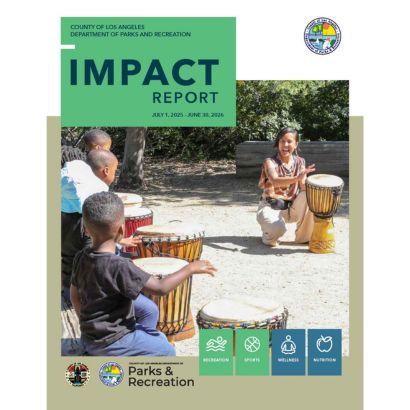
Our recently released 2025–2026 Impact Report at the County of Los Angeles Department of Parks and Recreation provides one example of how an agency can bring these pieces together. The report covers a year in which the department faced a $22 million budget reduction that required significant service and staffing reductions. Against that difficult backdrop, it shows how staff and partners worked together and did more with less, sustaining critical programs and services for communities across Los Angeles County.
An impact report provides an opportunity to see that work collectively rather than as a series of unrelated programs and projects. Our report captures accomplishments that might otherwise be viewed separately, from engaging 33,000 youth in sports and serving 71,825 congregate meals to seniors to wildlife rehabilitation efforts that have saved 700 raptors since July 2024. It also documents work involving aquatics, youth development, ecological restoration, new parks and trails, public safety, cultural programming, workforce development and major investments in parks and open space.
These examples are compelling individually, but their collective value may be the more important story. Viewed together, they illustrate the many roles parks and recreation agencies play in our communities while allowing numbers to be paired with context. For example, the report describes swim programs not only in terms of participation, but also as a means of reducing financial barriers to water-safety education, providing relief during extreme heat, supporting health and creating opportunities for mentorship and belonging. That connection between what we do and why it matters is at the heart of effective impact reporting.
Making the Case for Parks
In my previous article on telling our stories, I argued that we must consistently make the case for our field. Impact reports are one way to do that, but their value depends on the work that happens throughout the year: documenting accomplishments, measuring what matters and sharing stories that give the numbers meaning. Especially when resources are constrained, we need to make our impact visible. By combining meaningful data with compelling stories, we can show not only what we do, but why our work matters to people and communities.
Clement Lau, DPPD, FAICP, is Chief of Planning at the County of Los Angeles Department of Parks and Recreation. He is a regular contributor to NRPA's Parks & Recreation magazine and Open Space blog.