


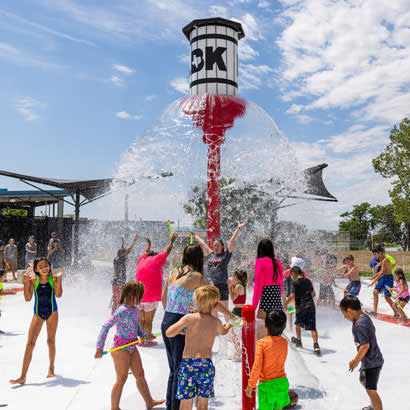
Pictured: Opening day of Maxey Splash Pad in City of Lubbock, Texas. Photo by Kraftsman Play marketing team, courtesy of Ruth Perkins.
“A successful summer camp season is one where all children feel welcomed and experience a true sense of belonging. It is a space where participants build new friendships, learn new skills, and feel encouraged to try activities they may have never experienced before. Throughout the summer, children gain confidence, develop social connections, and create positive memories in a supportive and inclusive environment. By the end of the season, participants leave feeling more confident, connected, and excited to return, while families feel confident in the quality and impact of the program.” -Courtney Galvan, Desert Recreation District, Indio, California
It’s that time of the year again! Park and recreation agencies across the country are gearing up for another whirlwind of summer, hosting camps, programs, and events. We know summer programming is a primary interest for families across the country, so NRPA surveyed the field to hear what you’re seeing on the ground as park and recreation professionals.
Summer Camp Programs Remain in Demand
- Two-thirds (66%) of summer camp programs are at or anticipate being at or above capacity.
- Nearly half (49%) of summer camp programs are full, with waiting lists.
- More than half (53%) of agencies indicate demand has increased this year compared to the past few years. (30% of respondents indicated no change year over year)
To help reduce barriers to access, scholarships are the most commonly used method of financial assistance (64%), but 93% indicate that some form of financial assistance exists.
Parks and Recreation Offers a Variety of Activities
Leveraging their unique ability to meet the many needs of community members, parks and recreation summer programs offer a vast array of opportunities for kids. The most popular programs and activities include field trips, team sports, aquatics (swimming and water safety), and free/unstructured play
Park and recreation professionals are also seeing a number of programs and activities gaining popularity, including visual arts and crafts (painting, pottery, photography, etc.), STEM, nature and outdoors programs (camping, hiking, survival, etc.), and performance arts (dance, music, theater, etc.)
Challenges and Opportunities to Support Professionals
Like all programming and activities, summer programs don’t come without their challenges. The biggest challenges heading into camp season include facility space limitations, staff training, and staff hiring.
To support these rising staff needs, more than 50% of agencies requested the following staff resources to help build capacity:
- Staff/instructor training resources
- Facilitated online discussions and resource sharing (trends, curricula, best practices, navigating challenges) before summer
- Facilitated online discussions and resource sharing after the summer
We hear you! Join us on Thursday, October 15, at 3 p.m. EST for ‘Thank Goodness It’s Fall! A Camp Season Discussion’ Sandbox. Swap stories, lessons learned, and creative wins from this summer camp season with fellow park and recreation professionals across the country. This is a space to exchange ideas, discuss what worked (and what didn’t), and gather inspiration for next year. Whether you’re looking to refine your approach or simply swap stories, your insights can help shape stronger camps for everyone.
More than 45% of agencies requested the following program resources:
- Template for measuring the impact of summer camp (community impact, economic impact)
- Facility space
- Supplies (sports equipment, science project items, etc.)
- Transportation assistance
Among respondents, areas of training not currently covered but desired include:
- Physical safety trainings: Mental health/trauma-informed care training, drug overdose response training, adaptive and inclusion training
- Facility and equipment inspection: Sports field dangers, water quality, indoor activities (e.g., proper ventilation, tripping hazards, etc.), playground dangers
- Environmental risk management: Animal-related (e.g., bee sting, snake bite, etc.), flooding signs, cold safety (e.g., hypothermia, sunburn, frostbite, etc.)
- Safe camper - Safe instructor: Navigating gender discrimination, sickness policies, racism
- Emergency action plans: Drug overdose, protests, raids and civil discourse
- Leadership and professionalism: Current and trending topics, measuring impact, career development
To support these training opportunities, partnerships are critical. Schools, enrichment specialists, public safety departments and local businesses are seen as the most valuable partners.
But above all, park and recreation professionals celebrate the successful opportunity to provide safe, supportive and engaging spaces for youth during the summer.
Maureen Neumann (she/her) is a senior program manager at NRPA.