


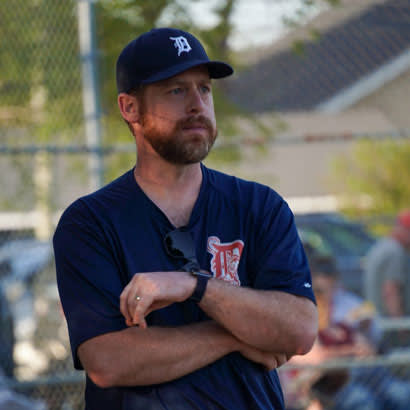
Pictured: Kent Hunt, NRPA program manager, looks over the baseball field.
Every spring, I shift into my alter ego: Coach Kent.
While I spend my days working alongside communities to strengthen youth sports programs, my nights are spent on a ballfield coaching baseball in my local recreation league.
On and off the field, kids are showing off their sliding mitts, comparing their baseball drip, and constantly asking if it’s their turn to hit. Someone is always misplacing a glove or hat, and someone always needs a little motivation after a tough moment.
Through it all, we’re not just teaching the basics of the game. We’re teaching how to be ready when your name is called and how to support your teammates, whether you’re on the field or in the dugout.
We talk a lot about what that looks like on my team, and we call it “PLAY B.A.L.L.” It usually sounds something like this:
Me: “What do I expect of you out there?”
Team: “PLAY Ball!”
Me: “What does PLAY stand for?”
Team: “It’s a game, have fun!”
Me: “What about the B?”
Team: “Be a team!”
Me: “The A?”
Team: “Attitudes, we keep them positive!”
Me: “First L?”
Team: “Listen to our coaches and teammates!”
Me: “Last L?”
Team: “Leave it all on the field!”
It’s not just about the team reciting it back to me. It’s when you see them live it out on the field, in practice, and in the dugout that you know they’re starting to understand the bigger picture.
It’s in those moments that you realize the true impact a coach can have.
But it’s also a reminder that not every program has the coaches or support in place to make those moments the norm. Across the country, youth sports programs in parks and recreation are facing a common challenge. There are not enough coaches, and sometimes not enough support for those who take on the role. Too often, coaching comes down to whoever is willing and available. Without the right guidance, even well-intentioned coaches can feel unprepared or prioritize winning over development, and that impacts the experience for kids.
When communities are intentional about building coaching pipelines, everything changes. When coaching is strong, youth sports programs get better. It becomes easier to recruit new coaches and create clear pathways for them to stay involved. With the right support in place, more coaches stick with it. Kids stay engaged longer. Teams feel more inclusive and reflective of their communities. Sports become what they are meant to be. Fun, developmental, and positive.
That’s why this work matters, and why I’m especially excited to introduce the newest grantees in our Building the Coaching Pipeline initiative, supported by GameChanger. These communities are working to strengthen existing pathways and create new ones into coaching, using thoughtful and innovative strategies.
Meet the Grantees
We’re proud to support the following communities as part of this cohort:
- West Allis–West Milwaukee Recreation Department, Wisconsin
- City of Orangeburg, South Carolina
- Blacksburg Parks and Recreation, Virginia
- Columbus County Parks and Recreation, North Carolina
- City of South Fulton Parks and Recreation, Georgia
While each community is designing an approach that fits their local needs, a few clear themes are emerging:
- Communities are rethinking how people enter coaching, creating more accessible and intentional pathways for parents, teens and community members. There’s also a growing focus on youth to coach pipelines, where young people are developed as future leaders and coaches within their own programs. For example, some communities are creating teen assistant coach roles that build leadership experience while also supporting current staff.
- At the same time, the goal is to make coaching more sustainable. The grantees have shifted their focus from filling roles for a season to building systems that help coaches grow, stay engaged, and return year after year.
- Taken together, this work reflects a bigger shift. Coaching should no longer be treated as a one-time need, but as something that can be built and sustained over time. While strategies may differ, the goal is the same. Build stronger pathways into coaching, support coaches to stay and grow, and create better experiences for every kid on the field.
This is just the beginning.
Over the next year, these communities will test and refine their approaches to strengthening the coaching pipeline. In early 2027, we’ll share what worked and the practical strategies other communities can use. Because this work is about more than filling coaching roles. It’s about strengthening the entire youth sports experience.
I’ll be back out there soon enough, on a baseball field, reminding kids to have fun, be good teammates, keep a positive attitude, listen and leave it all on the field.
I’m hopeful that because of efforts like these, more coaches will be stepping onto fields like mine. Better prepared. Better supported. Ready to create the kind of experience every kid deserves every time they step onto the field.
Kent Hunt is a program manager at NRPA.
Want to connect with your peers and help shape the future of youth sports together? Join us for the first-ever Youth Sports in Parks and Recreation Summit in Philadelphia, this September 27-28. We’re bringing together partners and leaders from across fields and sectors, as well as local Philadelphia sports leaders and youth, to learn together and explore effective strategies.